Anyone Can Build Anything
Sure, anyone can build anything now. But the afternoon prototype is the only easy part. Securing it, maintaining it, and fixing the edge cases is the real job, and it competes with everything else on your plate.

The headline is true… kind of.
AI genuinely has lowered traditional barriers related to building software, and it's done so to a degree worthy of vapid LinkedIn fodder like "What vibe coding taught me about B2B SaaS." No CS degree is needed to develop a working web or mobile app. No development team. No six-figure project cost or several month development timeline. In theory, any person with a laptop, the right AI tool(s), some willpower, and time can go from "I have an idea" to "I have a working prototype" in a single afternoon.
That last sentence is real. This type of scenario isn't a metaphor, it actually happens. And it is genuinely remarkable every single time.
Here's the part that flies under the radar and rarely hits headlines: while that afternoon can be truly valuable, it is the only easy part of the process.
An iceberg with only its small tip, labeled the prototype and one afternoon's work, above the waterline. The far larger mass below holds security review, edge cases, deployment, data connections, updates and rollbacks, and ongoing maintenance.
What "Building" Actually Requires
Before AI can even help you build something, you have to actually, truly understand your vision and needs well enough to describe it precisely. Using AI tools to build some app for yourself requires an ability to translate your idea to instructions… and yes, AI can help with that, too.
On top of that, you need to be able to recognize when the AI's output is wrong because sometimes it will be confidently, completely, and expensively wrong. You also need to understand where files live and how to navigate everything. You need to know how to convert your clickable prototype into a productized application. You need to know how to update your application and rollback any unintended updates. You need to know how your app connects to your existing data and whether the connections you've created are truly secure.
There are whole job titles built around the parts living in these gaps. QA engineers, DevOps, security reviewers, system architects. These gaps didn't disappear because AI got good at writing code, and the distance between "it works on my computer" and "it works reliably for actual customers, every time, including the weird edge cases" is not a small gap. A 2025 MIT study found that about 95% of enterprise generative AI pilots delivered no measurable impact, and the core issue wasn't model quality but the "learning gap" in integrating AI into real workflows.
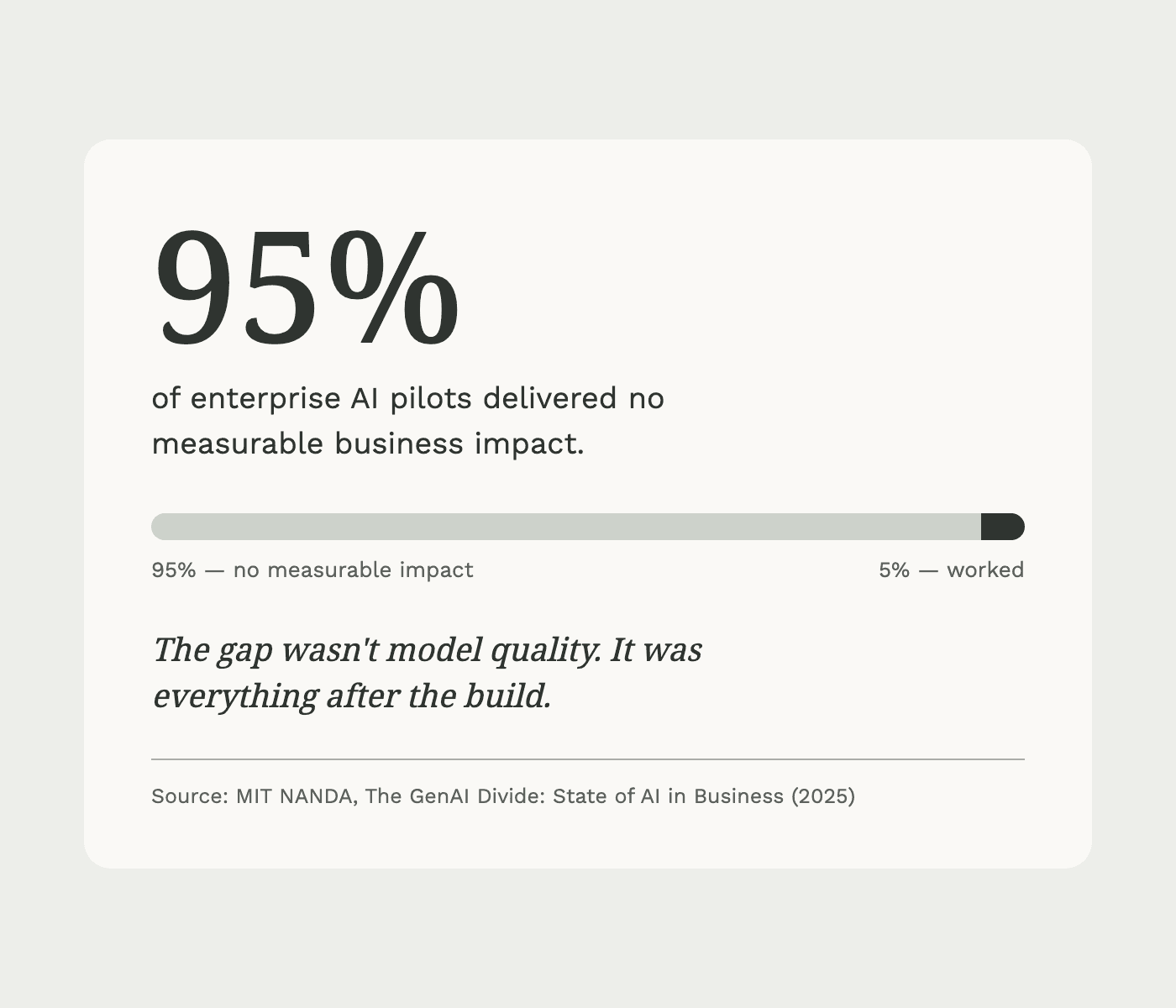 A stat card showing 95% of enterprise AI pilots delivered no measurable business impact, per MIT's 2025 GenAI Divide study. The gap wasn't model quality. It was everything after the build.
You need to ask the question most people skip: have you actually just built a very convincing-looking business liability? Even if you—plus a team, if that's the case—figure this hard part out, how do you ensure people actually use the solution?
While none of this requires a CS degree, all of it requires time. Real, focused, uninterrupted time that doesn't exactly grow on trees when you're already running a business.
So yes. Anyone can technically build anything now. But "can" is doing a lot of work in that sentence. Same as "build;" a one-shot output of a sleek-looking, clickable "prototype" isn't truly an app, it's just one step closer to something that is.
The 5-9 You Didn't Sign Up For
Business owners don't have slack time. That's basically the defining condition of running a small business. Days are already over-committed focusing on top concerns like business growth, labor costs, and talent sourcing, based on ADP's November 2025 Market Pulse survey. That doesn't even account for time spent fixing problems when things go sideways.
Where is a business owner supposed to fit AI upskilling, software development, deployment, and maintenance into their days?
So when someone tells you "you can build this yourself now with AI," what they're actually telling you is: you can take on a second job (or jobs). The Federal Reserve's 2026 Small Business Credit Survey noted that, among firms planning to adopt AI, two of the top issues were (1) adapting tools to meet business needs, and (2) the time required to implement tools and train employees.
Product manager. Developer. QA tester. Security reviewer. Ongoing maintainer. All of it on top of the business you're already running. Sure, you may have the technology now, but you're asking for headaches by taking on the biggest AI-based bottlenecks in parallel to everything else on your plate.
 A two-panel SpongeBob meme: Patrick proudly gestures at an old computer and says "We have technology," then recoils at it, baffled. Having the tools is not the same as knowing how to run them.
We made the case in our last blog that the real cost of manual business processes isn't just the hours, it's the compounding drag, decisions made without good data, the quiet weight of doing things the slow way because it's the only way you know.
The same logic applies to building software and automation with AI. Building your own tools with AI looks—and honestly is—cheap on the front end. A $20 Claude subscription probably does the trick. Maybe several hours one afternoon and you get a clickable prototype that actually looks like it could do the thing you need it to do.
If you manage to educate yourself to a point where that prototype successfully becomes a working piece of software, you then become the person responsible for monitoring and maintaining it. Every time the underlying AI model updates and something breaks. Every time a new edge case surfaces that the original build didn't account for. Every time your business grows and the thing you built eight months ago doesn't quite fit how you operate anymore. Every time a new employee needs to be trained on a system with no documentation because you built it yourself in an afternoon and documentation didn't feel urgent at the time. That doesn't even account for the assumption that you'd know how everything works under the hood if and when you need to dive in.
That's not a weekend project. That's an ongoing commitment, and for most business owners, it's a commitment that competes with everything else actually requiring your attention.
The question isn't whether you can do it. It's whether you should.
What the AI Moment Actually Changes
Here's the core of what I think this shift, this fourth industrial revolution, really means for small businesses. We've moved past the "learn to code" paradigm because the machines can now code for you. But the machines still need operators and overseers and optimizers.
Simply put, teaching yourself to become a modern-day pseudo software engineer is not the highest-value way to spend your time. As a business owner, you need solutions to your problems. Not new tools and knowledge that may help you build solutions after a learning curve period… you just need the solutions.
AI has truly made skilled, receptive technical talent dramatically more productive. More productive talent means more accessible talent. A small, sharp team can now build and maintain software that would've required a team at least three times bigger just a few years ago. The economics change. The timeline compresses. The projects that were financially and logistically out of reach are now buildable and affordable.
 The Zoolander meme: Derek squints at a tiny model building and says it needs to be at least 3 times bigger than this. A small, sharp team can now build what used to take a team three times the size.
That's the actual unlock. Not a new DIY path but an affordable path to real expertise.
Think about the gap that's existed for decades. Large companies get the custom build: software designed around how their operations actually run, dedicated support, a solution that evolves as the business does. This traditionally has been done through dedicated internal engineering employees or teams. Now, forward deployed engineers are surging in demand.
On the other hand, small businesses had to settle for the off-the-shelf options. The ones that cover maybe 50% of their needs very well, 25% of their needs somewhat well, and completely ignores the final 25% of their needs. Solutions to fill these gaps have traditionally been manual, ad hoc workarounds that quietly increase in cost by way of time and dollar creep month by month, year after year.
The gap between what's possible for large companies and small businesses is closing. It's not because business owners are quickly becoming "10x productivity engineers," rather development itself has become more efficient. And that efficiency is passing through to the smaller businesses by way of a more accessible price of top tier technical talent.
So… Should You Build It Yourself?
If you want to, genuinely, and you have the time and interest to develop software engineering competency… then yes. Go for it. The tools are there, they're honestly impressive, and there has never been a better or easier time to upskill. There's a legitimate path for you and anyone else to get to a point where you can annoyingly badger your formally trained software engineering friends that you're on their level.
If you're a business owner who's heard about how AI could transform your operation but you're still trying to figure out where to start, the answer probably isn't to try and become a developer. Sure, anyone can build anything now. But what hasn't changed is that your time is finite, and what you do with it compounds.
The answer is to get clear on what's actually slowing your business down and find people already equipped to fix it. The same MIT study mentioned earlier suggests AI pilots that paired internal teams with outside expertise hit a 67% success rate, versus just 22% for builds done entirely in-house.
The cost of pairing internal teams with outside help, or simply outsourcing entirely, has changed significantly. The level of access teams have now has changed significantly. The old trade-off between custom and off-the-shelf has changed significantly.
The good news: these changes are all in your favor.