The True Cost of Doing Things Manually
A day at the Small Business Expo made one thing clear: the room had the AI question backwards. The real cost of doing things manually isn't the lost hours, it's the margin of error quietly inviting and compounding missed opportunities.
I spent a day at the Small Business Expo at the Javits Center recently. No booth or pitch. I just wanted to walk the floor and talk to the people who showed up: small business owners who took a full day away from running their businesses to be there.
These owners chose to be in that room. By the show's own numbers, roughly 80% of attendees say they are ready to buy a product or service within the next twelve months. They know they need to stay on top of their game in order to succeed, so they came to learn about what they lack from those claiming to sell solutions. Over 40% of the workshops and keynotes were about one thing: AI. Marketing materials at most exhibitor booths said the same thing.
 Small Business Expo attendee demographics: 73% run companies under 50 employees, 81% are owners or C-level executives, and 82% plan to make a purchase within twelve months.
The message was everywhere, and it was always the same. AI is here. You need to be using it. You can prompt like this. You can get it to write in your voice. You can automate your busywork. You can grow your business with AI.
None of that is wrong. But when 40% of what you hear all day says the same thing in slightly different ways, it doesn't make anything clearer. It complicates the issue.
Does an owner need one of these products or services? Two? Five? If it's true that these small business owners can "build AI solutions" themselves (it was said many times throughout the conference), then what and why is everyone selling? And if it's really that easy, why does anyone need to pay for help at all?
I left thinking the room had the question backwards.
Two Camps That Want the Same Thing
There's a split among business owners staring down new technology.
One side of the equation says, "I don't want to think about it, I just need something that works." The other side is more, "Forget it, I'll do it myself." Vendors sell to the first camp. Educators court the second. Both were well represented at the Javits Center.
The pitch fails both of them, though. That's because it's selling a category instead of solving a problem. "AI" is not a problem you have. It's a tool. Telling a pharmacy owner she needs AI is like telling someone with a leaky roof they need a hammer.
What both camps actually want is simpler than the pitch lets on. Small business owners want peace of mind. The owner who hires help and the owner who builds it themselves want the same underlying thing: to know that a job is done right. Securely. On their own terms. Sustainable. And all without seemingly lighting a pile of money on fire.
 A man in a bathrobe stands over a backyard grill with cash going up in flames: what paying for tools that never deliver can feel like.
If it's a leaky roof, the homeowner simply wants to know their new roof won't start leaking again. Anyone with a leaky roof knows they could, theoretically, use a hammer and some other tools to patch things up. Or, they could hire a professional. Either way, the problem has to get fixed so everyone can move on.
If it's a small business problem, the owner also simply wants a problem fixed so they can move on. Nobody on stage at the Small Business Expo was selling peace of mind. They were selling urgency. And urgency without a specific problem to point at is just noise.
The Cost Isn't Time. It's the Margin of Error.
When people talk about doing things manually, they often frame it as a time problem. Hours lost to data entry. An afternoon spent reformatting a report. Having to work late to shore up some nagging, nuanced thing. And of course that's real. Around 60% of workers say they could save more than six hours a week if the repetitive parts of their jobs were automated.
But the hours lost aren't the most interesting part of the story.
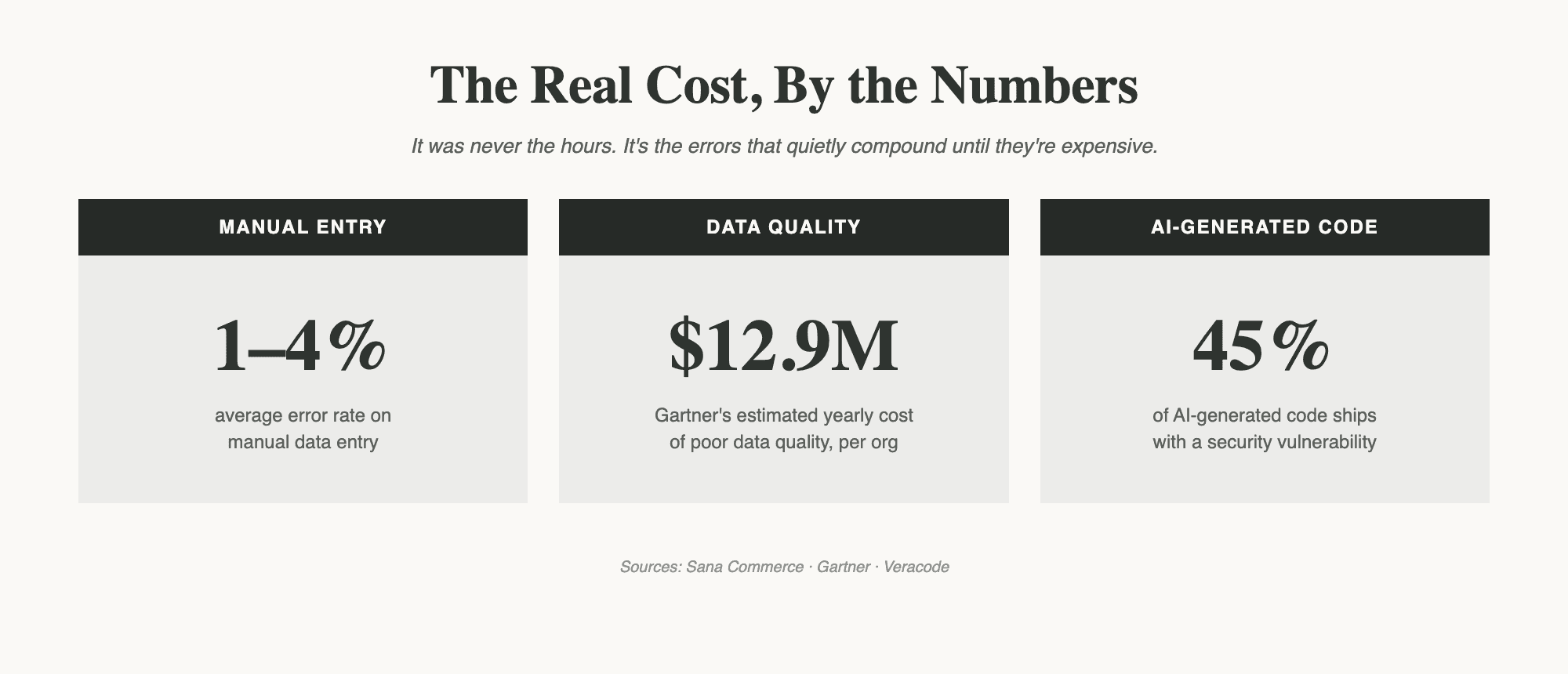
The real costs start piling up when processes solely rely on human hands. Think clipboards, spreadsheets, and stacks of mail on the corner of a desk. This all invites at least some margin of error. Manual data entry carries an error rate of roughly 1 to 4%. That sounds tiny until you do the math on a business that processes thousands of records a month.
That's the part of the story that a time-savings perspective misses. The error doesn't just stay an error. It becomes a failed compliance upload. A bill that surfaces only when past due. A purchasing decision that was made on gut feel because nobody had a clear picture this week, next week, a month from now, and so on. Gartner pegs the cost of poor data quality at around $12.9 million a year per organization. That's a big number I can't readily contextualize to business size, region, or other qualifiers because that information isn't cited in my Claude-sourced citation. But Gartner is generally a respected source on things like this, and the only point I'm trying to make is that the cost isn't $0.
The point: small, individually-forgivable mistakes compound over time and really gum up the works.
Margin of error becomes missed opportunities, one after the other. When businesses can't clearly see the leak, it can't get fixed. When solutions actually get implemented, they don't hold. This is the vicious cycle that needs breaking.
That's the hidden cost of doing it manually. Not the hour. The blindness and what it produces.
"It's So Easy You Could Just Build It Yourself"
This was a pervasive sentiment across speakers and workshops at the conference. It deserves a hard look.
"Build me a website and write the marketing in my voice." Great. Generative AI can take a real swing at that today. It can probably be pretty good. Maybe what gets shown to you makes it to a live website. But then what? Who maintains it? Who secures it? Who confirms the output actually sounds like you over time and fixes bugs that pop up? Would you understand what's under the hood if you even get to peek inside?
You don't know what you don't know. Nobody does. The gap between "I can click it on my screen" and "it's safe to put in front of customers" or "I'm confident in connecting my banking information to this app" is where people get hurt.
The data here is not subtle. Veracode's 2025 GenAI Code Security Report found that 45% of AI-generated code ships with security vulnerabilities. Carnegie Mellon researchers found that while 61% of AI-generated code functions correctly, only 10.5% passes security review. Read that again. The code runs. The demo works. And fewer than eleven snippets in a hundred clear a basic security bar. The thing looks finished long before it's safe. That's the trap. "Looks finished" is the only leg a non-technical owner has to stand on.
 A chart from Veracode's GenAI Code Security Report showing security pass rates for AI-generated code holding near 50% across model sizes and release dates from 2023 to 2025.
If you know any Software Engineers who learned their craft prior to ChatGPT's release in December 2022, they'll probably agree.
Now, I want to be fair. The easy version of this argument is also wrong. AI can help an owner climb the learning curve. Some will climb it. Some will even enjoy it. In fact, I use these tools every day and find it both interesting and effective as a new way of working. The point isn't that owners are incapable, it's that there's possibly a smarter way to spend talent and resources than turning every business owner into a part-time security engineer.
Here's the kicker: buying your way out doesn't fix it either. The average company has piled up more than 100 SaaS subscriptions, and the number seems to be falling (it's down 18% from its 2022 peak) because owners are rightfully cutting tools they bought and never got value from. Buying the fifth app and vibe-coding the sixth are the same mistake pointed in opposite directions. Neither is a solution. Both are just more stuff to manage.
What Solving the Problem Actually Looks Like
We've lived it with real clients.
Healthcare Leaders of New York ran every event on paper sign-in sheets. After the room cleared, staff had a second job: hand-translating attendance data into the strict format their national organization required to award continuing education credits. A missed field or a misread signature meant the upload failed. Or worse, it went through wrong. So we built a tablet app that captures every required field at sign-in and writes the compliance export itself the moment an event ends. That way, incorrect information now doesn't cause headaches later. And the hour of reformatting isn't shortened, it's gone.
Thriftway Pharmacy had the opposite-looking problem with the same root. An independent NYC pharmacy gets buried in physical mail: bills, compliance notices, government correspondence. It's all managed by the same people running the floor. Important documents went unnoticed until they became urgent. Having to think about stocking the shelves led to lapses. So, we digitized the whole mail stream, made it searchable in plain language, and wired it into a forward-looking cash calendar. Purchasing decisions now get made against what's actually in the account and what's forecasted, not hunches.
Healthcare Leaders of New York: Event sign-in that writes the compliance report itself.
Thriftway Pharmacy: Physical mail, made searchable and wired into a financial plan.
Here's the takeaway. In both cases, AI is in our toolkit. It's a hammer that helps our solution read documents and answer plain-language questions. "AI" wasn't the answer, it was a means to it. The problem got removed.
AI is a component in how we build, not what we sell. And it always runs on your data, about your business… not some generic or bloated model trained on everyone else's.
That's the line. Data is the new oil, and there's a fortune of it sitting untapped in the daily run of a small business. The pen-and-paper. The tribal knowledge. The "we've always done it this way." The opportunity is to capture that and put it to work for you.
The trap is doing it the way Meta does it through surveilling employee keystrokes to train their eventual, post-human-layoffs successors: "AI agents." We're not interested in that, and neither should you. Our goal is to empower the team you have, not give you a reason to shrink it.
Hire a Problem-Solver Before You Buy Another Tool
The way out of the cycle isn't more DIY AI, and it isn't more out-of-the-box software. It's a partner who starts ideating and designing solutions only after understanding your actual processes and problems.
Stop buying another point solution and start with the question nobody at the expo was asking: what is actually slowing you down, and what would it take to make it stop?
Most of our clients didn't know they needed us. They just knew something was taking too long, slipping through the cracks, costing more than it should. They couldn't see it clearly, so they couldn't fix it.
If something on your side feels like that, tell us. The first conversation is no pressure and totally free.